
The capon is a young castrated rooster, raised specifically for its exceptional meat. Its meat is juicy and flavourful, as the fat, unlike in hens, does not accumulate in one place but is marbled throughout the muscle tissue. Our capons are raised on a local farm, where they have plenty of sunshine and space to move freely, and are fed only home-grown feed.
In the past, the exceptional quality of capon meat served as the foundation for creating many dishes, most of which were festive in character and significance. Today, capon continues to delight guests from Slovenia and abroad, and has been a culinary speciality of our house for many years.
Order Your Capon:
Capon is available by pre-order one day in advance, as it is roasted especially for you and your guests, together with side dishes. A roasted capon weighs between 2.3 and 3 kg and is larger than a chicken, making it suitable for four guests. Only a whole capon can be ordered. Price with side dishes: €45/kg.
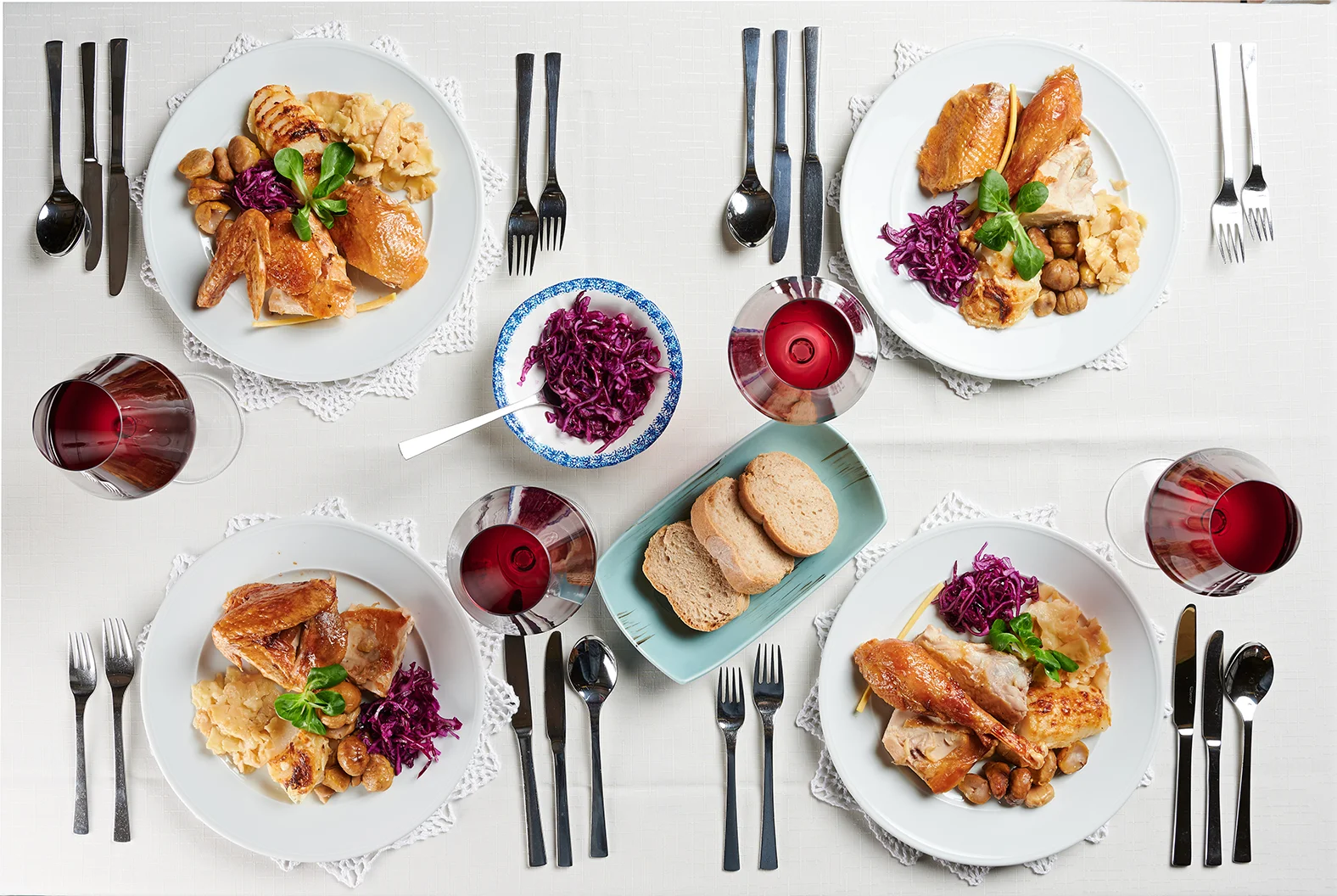
"The capon is a castrated rooster that holds an important place in the culinary cultures of Slovenia and Europe. The quality of capon meat has inspired the creation of many dishes, most of which were festive in character and significance. Even the ancient Romans regarded roasted capon, glazed with honey, as a delicacy. It was prepared in a similar way in castles and for festive occasions in monastery kitchens. Above all, the capon symbolised abundance and was therefore, throughout history, mainly associated with the diet of privileged social groups.
In the diet of the rural population, capon was less common until the second half of the 19th century, as it was often given as a levy to landowners and appeared on the farmer’s festive table only on rare occasions. It is therefore no surprise that several ways of preparing capon are also included in the first cookbook written in the Slovenian language: Valentin Vodnik’s Kuharske bukve (Cookery Book), published in Ljubljana in 1799. Its purpose was to educate and raise the level of cooking, including among the rural population. Drawing on foreign sources, Vodnik includes two capon recipes in the chapter “Boiled, Steamed and Minced Dishes of Meat and Poultry”: “capon with oysters” and “roasted capon stuffed with oysters”. He also provides special instructions on how to properly carve a roasted capon. In Slovenska kuharica (The Slovenian Cook) by Magdalena Pleiweis, published in Ljubljana in 1868, and in later editions expanded by Felicita Kalinšek, there are even more recipes for preparing capon and dishes made with capon meat. These include instructions for preparing roasted capon as a roast, using capon meat in various types of stews, and serving capon meat with sauces. Capon is also a characteristic ingredient in French cuisine, where roasted capon is a traditional Christmas dish."